Systems engineering
How can a wrong unit throw a spacecraft off course?
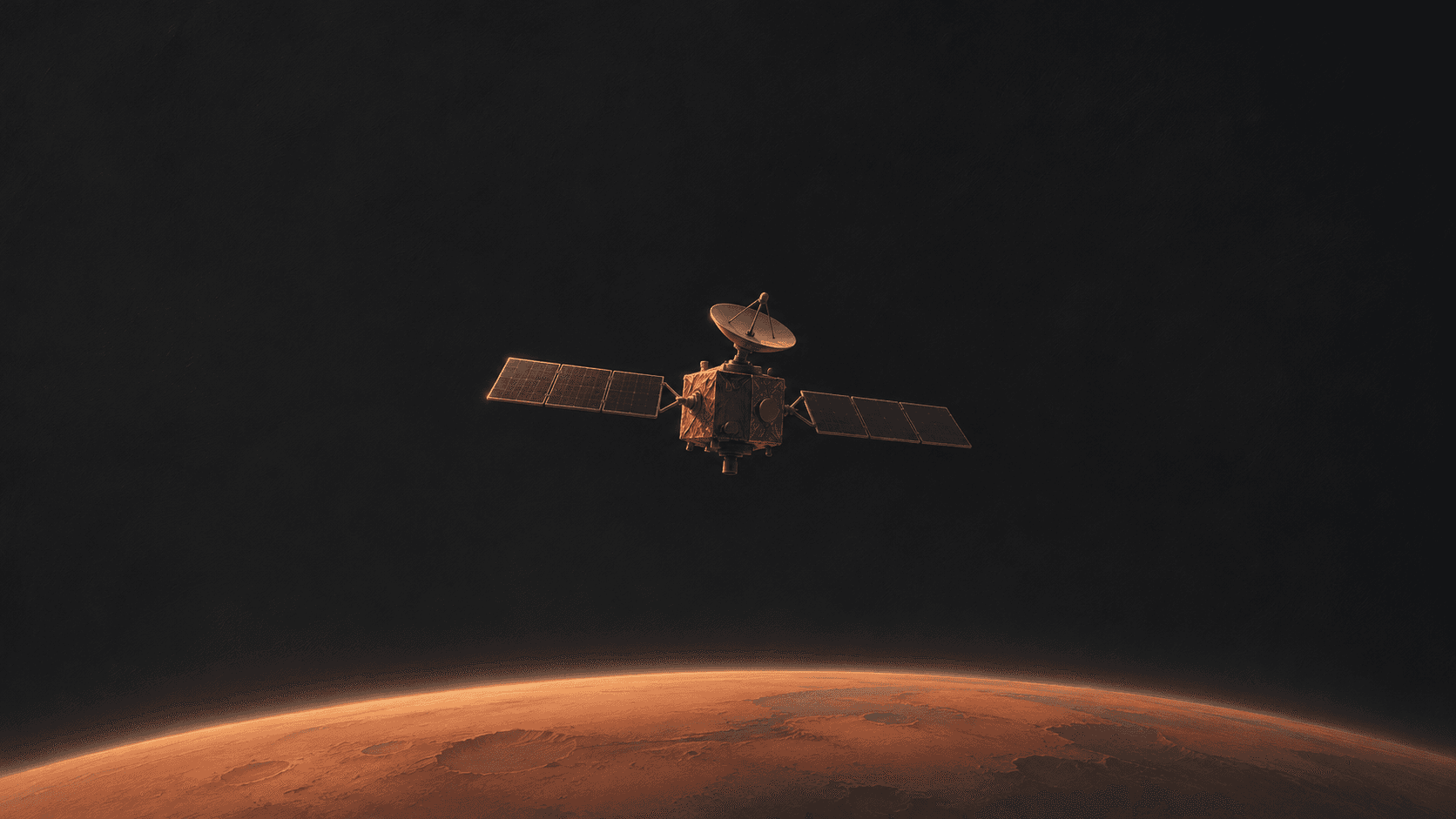
On September 23, 1999, the Mars Climate Orbiter was supposed to enter orbit around Mars. As seen from Earth, the spacecraft disappeared behind the planet shortly after firing its main engine, 49 seconds earlier than predicted. After that, it was never heard from again. A few days later, experts found an error in a data handoff on the ground: one program supplied values in pound-force seconds, while navigation treated them as newton-seconds.[1]
What the file was supposed to tell navigation
Reaction wheels helped the spacecraft maintain its orientation. The pressure of sunlight caused the wheels to gradually build up angular momentum. Short thruster firings shed this excess and, in doing so, slightly changed the trajectory. The ground program supplied data on these thrust impulses so that navigation could factor in the small changes. When the thrust force stays constant, the impulse is the product of force and duration.[1]
According to the interface specification, the ground program was supposed to supply the impulses in newton-seconds. It wrote them in pound-force seconds. One pound-force second equals about 4.45 newton-seconds. In the worked example, navigation therefore reads the number 1 as 1 newton-second, even though it stands for about 4.45 newton-seconds. It calculates with just under a quarter of the correct value. The number 1 is chosen arbitrarily. The onboard software used the correct units for its calculation of the thruster firings.[1]
One number, two readings
Simplified worked example using the arbitrarily chosen number 1. Not a reconstruction of the original file.
Ground program writes
1 lbf·sActual unit in the example: pound-force seconds (lbf·s).
File passes on example number
1Navigation reads
1 N·sInterface requirement: newton-seconds (N·s).
Trajectory estimate on the ground
The calculated effect is underestimated.
Correctly converted
1 lbf·s ≈ 4.45 N·s
Checkpoint in the example: about 4.45 N·s expected, 1 N·s processed.
What trajectory the team expected
The maneuvers were needed 10 to 14 times as often as expected. During the first four months of flight, the navigation team did not yet use the files for orbit determination because of other format problems. When it began using them in April, the effects that were too small were quickly noticed. The cause was found only after the signal was lost.[1]
For the first point of closest approach to Mars after the orbit insertion maneuver, the team had expected an altitude of 226 kilometers. With the corrected impulse values, the later estimate came to 57 kilometers. Regarding the fate of the spacecraft, the summary of the investigation report names two possibilities: it may have been destroyed in the atmosphere, or it may have left the atmosphere again and entered an orbit around the Sun.[1]
Planned value and later estimate
Altitude above the Martian surface at the first point of closest approach to Mars after the planned orbit insertion maneuver.
- Value planned at the time
- 226 km
- Later navigation estimate
- 57 km
The values are not measured flight altitudes and not a safety limit. They do not show where the spacecraft ended up.
Source: investigation report, pp. 13–14.
View NASA sketch (Figure 4, PDF page 14; not to scale)How a data handoff can be checked
The board identified the unit error as the root cause and named further contributing factors. The ground software had apparently not been verified end to end against its requirements. According to the report, the checking of individual ground interfaces was also incomplete or not thorough enough.[1]
A simplified interface test could specify a thruster firing with a known impulse and trace the value through the ground program and the file all the way to the navigation software. If navigation processes only 1 newton-second when a value of about 4.45 newton-seconds is expected, the comparison reveals the discrepancy. Such a test is given here as an example.
The board also names an option that uses data from the flight: the spacecraft calculated the velocity changes caused by its thruster firings and radioed them to Earth. In the board's assessment, an early comparison with the tracking data might have exposed the problem.[1]
The NASA Systems Engineering Handbook describes the general verification process. The documented requirements of an interface feed into the objectives and plans for verification. Applied to the orbiter, this means that the unit specified in the interface specification is a verification criterion in its own right.[2]
Sources
[1] NASA Mars Climate Orbiter Mishap Investigation Board: Phase I Report. November 10, 1999.
Open original source [1][2] NASA: NASA Systems Engineering Handbook. NASA/SP-2016-6105 Rev. 2, Section 6.3.1.2.3, p. 137.
Open original source [2]