Sustainability
When does a reusable container have the better climate footprint?
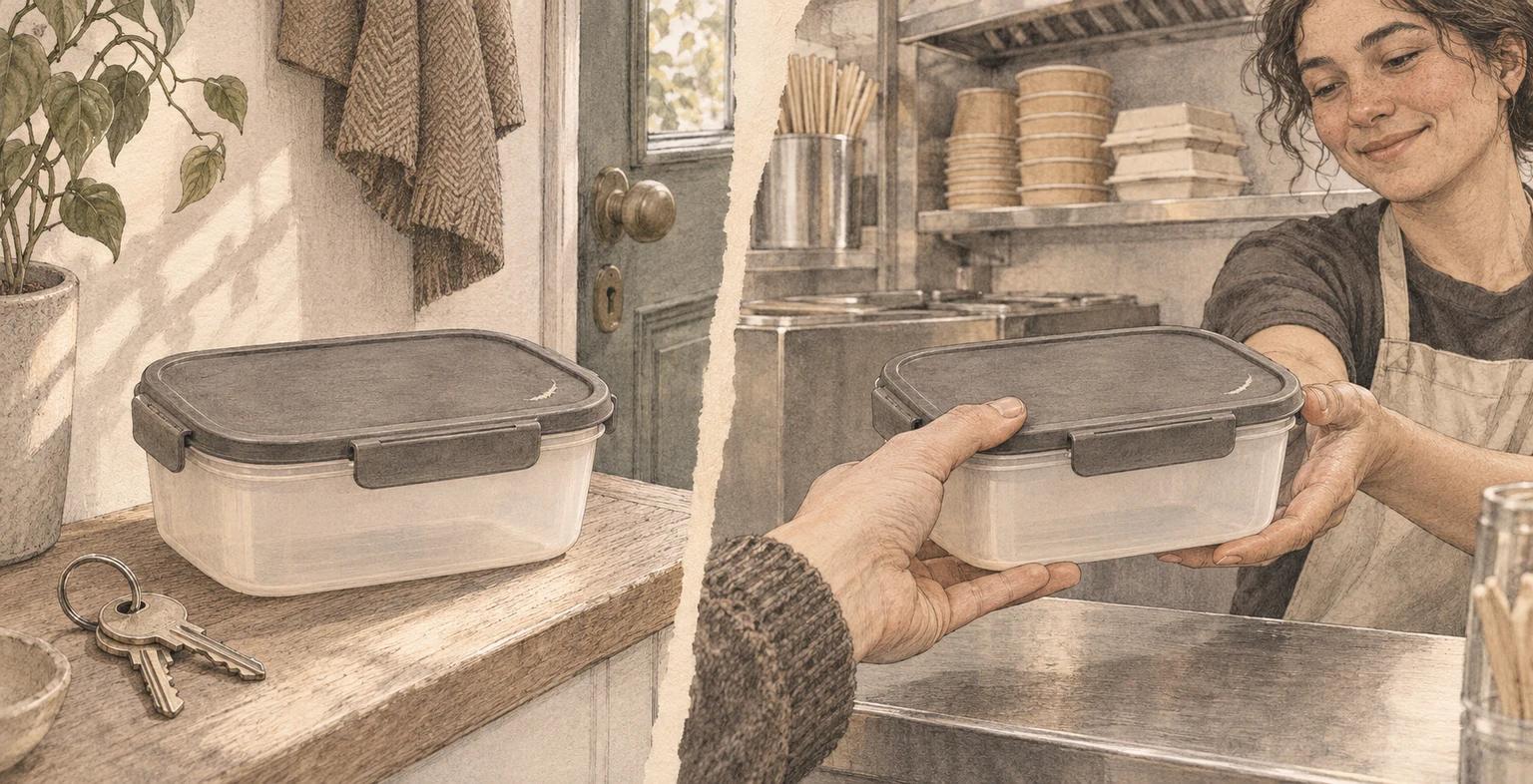
The empty container from lunch is sitting by the front door. Tomorrow, the commute to work passes the takeaway anyway. Today, returning it would mean a separate car journey across town. Either way, the takeaway gets the same container back. For its climate footprint, the route it takes to get there makes a difference.
Four uses for one container, eighteen for the other
How much does the packaging for one portion of takeaway food burden the environment? A team led by Alejandro Gallego-Schmid at the University of Manchester investigated this question and compared different containers. In the calculation, all of them held 670 millilitres. One of the comparators was a lightweight single-use container made of foamed polystyrene. Every additional portion requires a new one. A reused container is manufactured once and washed between uses. The more often food is handed over the counter in it, the smaller the share of its manufacture in the climate footprint of a portion. [1]
The team ran the numbers for two very different containers made of the plastic polypropylene. The lightweight takeaway container contained around 32 grams of it. Such containers are mostly regarded as single-use items, but they can be washed and used again. The household container contained around 133 grams of polypropylene, plus a silicone gasket. For the takeaway container, the study gives four uses before its greenhouse gas footprint per portion draws level with that of the single-use container. For the household container, it gives eighteen. Washing is included in these figures; the customers' journey to the takeaway is not. [1]
| Reused container | Uses to break even |
|---|---|
| Lightweight takeaway container | 4 |
| Household container with silicone gasket | 18 |
Greenhouse gases per portion, including washing, are taken into account. Customers' journeys are excluded.
Adapted excerpt from Table 3 of A. Gallego-Schmid, J. M. F. Mendoza and A. Azapagic (2019), Journal of Cleaner Production 211. Two global warming potential values selected, rows and columns swapped, and labels translated. DOI · Original table · Licence CC BY 4.0Both figures apply only to this comparison and only to greenhouse gases. Compared with a single-use aluminium container, fewer uses are enough. For other environmental impacts, the number is in some cases considerably higher. If the household container stays in the cupboard after the first lunch, the burden of its manufacture is spread over a single portion. [1]
The way back
In Ann Arbor, in the US state of Michigan, a team led by Christian Hitt also looked at the return of the containers. In the baseline case of the modelling, the reusable container studied performed better on most indicators than comparable single-use containers. The team then worked through a different case. It assumed that five in a hundred customers set off specifically to return the container. In this scenario, the reuse system caused more greenhouse gases overall than single-use. How many customers in Ann Arbor actually made such a trip cannot be read from the modelling. [2]
Back to the container by the front door. If the customer drops it off at the takeaway tomorrow on the commute that is planned anyway, the additional car journey is avoided. In this way, the location of a return point can also influence the climate footprint. [2]
Two routes for the same container
Return along the way
Tomorrow, the journey goes from home to work. The takeaway is on the way. The container changes hands there.
A trip just for the return
Today, the journey goes specifically from home to the takeaway and back again. Tomorrow's commute still has to be made.
Sources
[1] A. Gallego-Schmid, J. M. F. Mendoza, A. Azapagic (2019). Environmental impacts of takeaway food containers. Journal of Cleaner Production 211, 417–427, Tables 1 and 3.
Open original source [1][2] C. Hitt, J. Douglas, G. Keoleian (2023). Parametric life cycle assessment modeling of reusable and single-use restaurant food container systems. Resources, Conservation and Recycling 190, 106862.
Open original source [2]Original abstract at the Center for Sustainable Systems · Explanation of the trip by the University of Michigan