Mechatronics
How can a bag full of grains become a robot gripper?
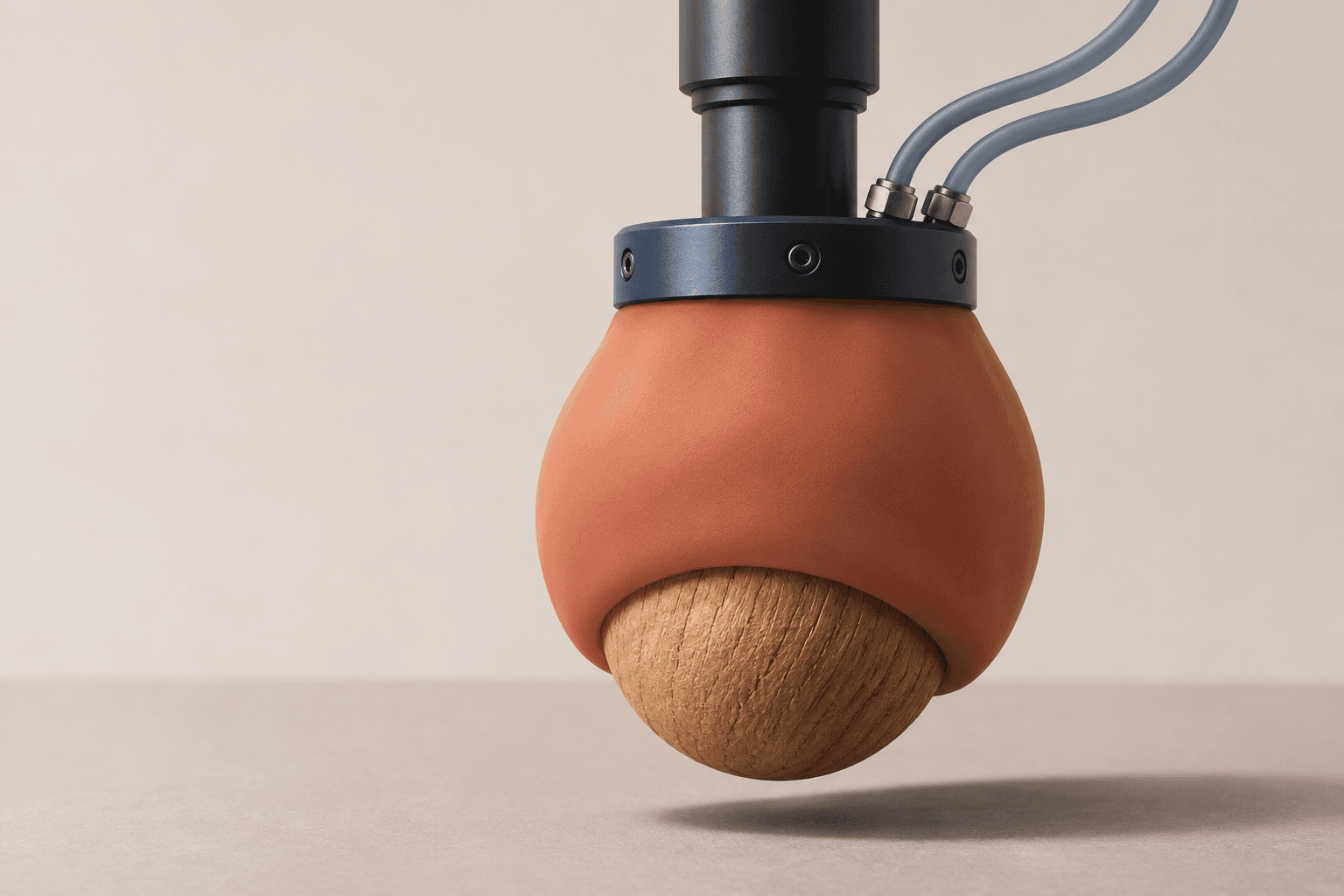
A soft bag can mold itself around an object and then become firm enough to hold it. To do this, air is sucked out of the bag. The grains inside can then barely slide past one another. In 2010, a research team from the United States showed how this principle can be used for a robot gripper.[1]
First conform, then hold on
The 2010 gripper consisted of a thin, airtight rubber membrane loosely filled with ground coffee. A robot arm pressed the soft bag onto an object. In the process, the membrane and its filling adapted to the object's shape.[1]
Air was then sucked out of the bag. The lower pressure inside lets the surrounding air squeeze the membrane together from the outside. The grains jam together, and the filling becomes stiff. In doing so, it largely keeps the shape it has taken on. This transition is called jamming.[1]
The filling barely shrinks in the process. In measurements using fine glass beads instead of coffee, its volume decreased by less than half a percent.[1] The suction line connects only to the inside of the bag.
Original figure [1]: Fig. 1 – gripper and pickup testsWhat holds the object
The researchers distinguish three mechanisms that can work together.[1][2]
Friction: The slight decrease in volume presses the membrane against the object. Friction at this contact can keep the object from slipping out.[1]
Wrapping around: If the membrane wraps around suitable protrusions, its stiffened shape makes it harder to pull the object out.[1]
Suction: If the membrane forms an airtight ring of contact, negative pressure can develop in the enclosed gap when the object is lifted. Jamming first forms the seal; it does not yet create any negative pressure there.[1]
If the contact cannot be sealed because of pores or uneven surfaces, this additional suction effect is lost. Friction or wrapping around can still provide a hold.[1] The negative pressure inside the bag and a possible suction effect on the object are two different things.
Three kinds of hold
Frictional contact
The membrane presses sideways against the object. Friction at the contact counteracts slipping out.
Wrapping around a protrusion
The stiff membrane lies around a suitable protrusion. The shape makes it harder to pull the object out.
Sealing a gap
With an airtight contact, the additional negative pressure develops in the enclosed gap only during lifting. It is separate from the inside of the bag.
Where control comes into play
For the next grip, the filling has to become movable again. In 2012, the team described a further development in which a burst of air replaces the previous manual resetting by shaking or kneading.[2]
While the bag is being pressed on, it is at normal air pressure. To hold the object, air is sucked out. At the drop-off point, the negative pressure is first released. Then a short burst of air frees the object and loosens the filling. In the experiment described, this burst lasted a tenth of a second. Solenoid valves switched between the pressure states, controlled via the robot arm.[2]
The robot moved to fixed, preprogrammed positions. The gripping sequence ran without a camera or sensory feedback about the grip, but it did require a controller as well as compressed-air and vacuum supplies. Recognizing or searching for objects on its own was not part of this setup.[2]
As an editorial interpretation, this illustrates mechatronics: the program and valves control pressure and movement, while the deformable mechanics take care of adapting to the shape.
One grip in five states
Our own simplified cross-section based on the 2012 setup. The membrane stays closed; only its interior is connected to the air supply.
The bag is at normal air pressure. As it is pressed on, the membrane and the loose grains adapt to the object.
Press on softly
The bag is at normal air pressure. As it is pressed on, the membrane and the loose grains adapt to the object.
Evacuate the bag
Air flows through the filter to the vacuum supply. The ambient pressure presses the membrane against the grains; they jam. The bag stays almost the same size. No air is sucked out of the gap at the object.
Hold and lift
The stiffened filling keeps its shape. Only if the contact is sealed can additional negative pressure build up in the separate gap during lifting. There is no line from the gap to the pump.
Release the negative pressure
At the drop-off point, the pressure in the bag is equalized with the surroundings. The filling can give way, and the grip may already loosen.
Short burst of air
Compressed air enters the bag. It helps release the object and loosens the filling for the next grip. This is a separate step after pressure equalization.
Components and separate spaces
- A
- Vacuum supply
- B
- Compressed-air supply
- C
- Ambient air / pressure equalization
- D
- Controlled valves
- E
- Filter and internal airway
- F
- Closed membrane with grains
- G
- Object outside the membrane
- H
- Sealed gap – only during lifting
Why “universal” has limits
With the 2010 setup, all ten pickup attempts succeeded for each of many selected objects. These included bottle caps and foam earplugs, for example. How firm the grip was depended on the shape.[1]
A thin disk lying flat could not be picked up: the membrane did not reach far enough around its sides. Large hemispheres and a very soft cotton ball also caused problems for this setup.[1] Among other things, the 2012 paper mentions a coin that was gripped.[2]
“Universal” refers to adapting to many shapes. The experiments do not demonstrate a secure grip for every material and every size. The researchers themselves described the further development as an early prototype.[2]
All five authors of the 2012 paper had already been involved in the 2010 work. The papers are not independent replications.[1][2] According to the first paper, four of those involved and iRobot filed patent applications for related technology.[1]
Sources
[1] Eric Brown, Nicholas Rodenberg, John Amend, Annan Mozeika, Erik Steltz, Mitchell R. Zakin, Hod Lipson, Heinrich M. Jaeger: Universal robotic gripper based on the jamming of granular material. PNAS 107(44), 2010, 18809–18814.
Open original source [1][2] John R. Amend Jr., Eric Brown, Nicholas Rodenberg, Heinrich M. Jaeger, Hod Lipson: A Positive Pressure Universal Gripper Based on the Jamming of Granular Material. IEEE Transactions on Robotics 28(2), 2012, 341–350.
Open original source [2]