Mechanics
Why can a bicycle keep rolling upright without a rider?
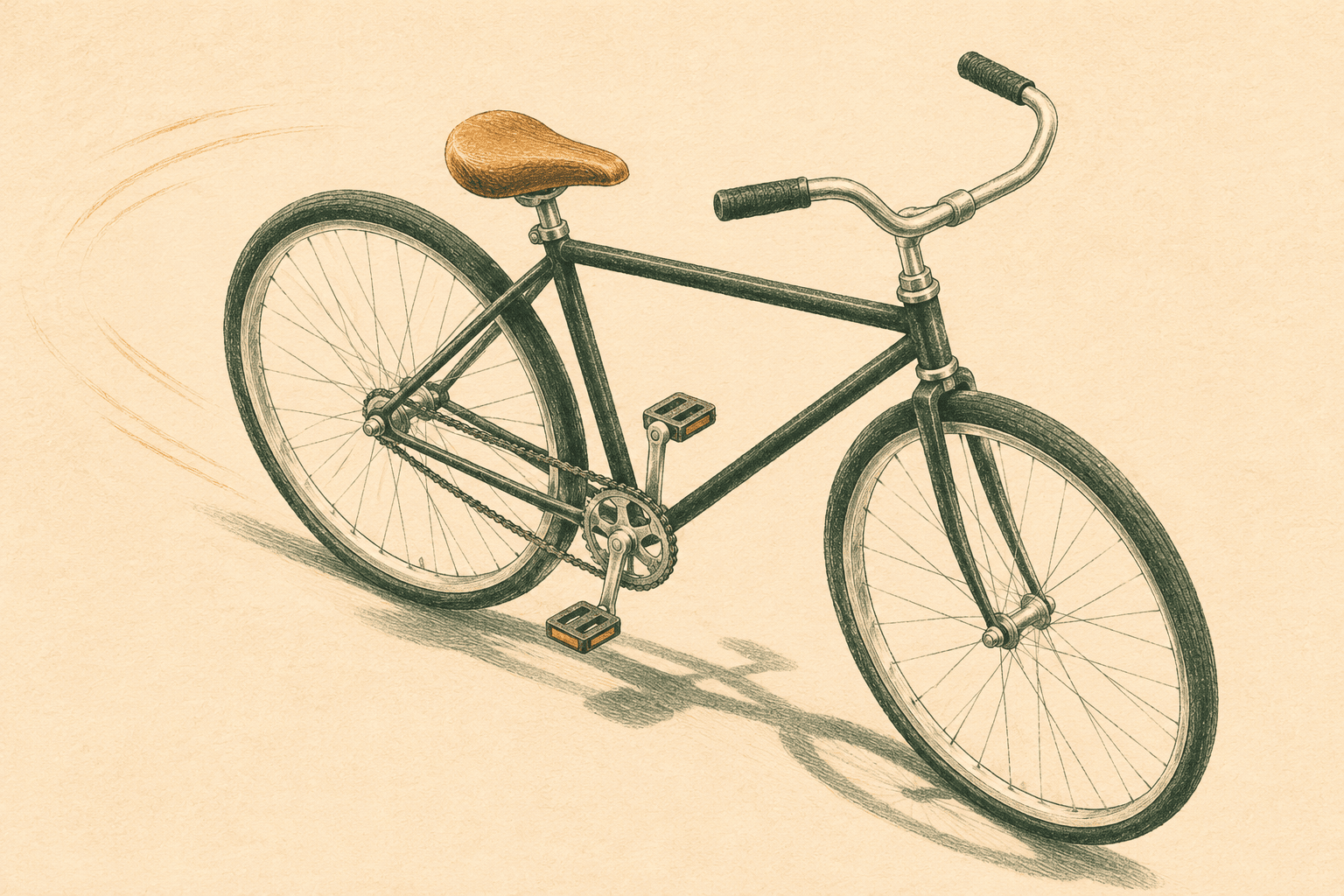
A bicycle that has been given a push can keep rolling upright without a rider because it catches itself with small steering movements. If it tips to the right, the front wheel can steer to the right and counteract the tipping. This works only with a suitable design and speed. In 2011, a research team showed that a bicycle needs neither a strong gyroscopic effect from its wheels nor the usual trail of the front wheel to do this.[1]
Steering catches the fall
When a bicycle is straight and upright, its center of mass lies above the imaginary line between the two points where the wheels touch the ground. If it tips to one side, steering can help: the wheels follow a curve toward the side of the lean, which moves their ground contact points back under the center of mass.[2]
The researchers compare this to balancing a broomstick on the palm of your hand. The hand moves under the tipping stick. On a bicycle without a rider, the right steering movement has to arise from the mechanics: the handlebars, fork and front wheel form the movable front assembly. Its connection to the rest of the frame allows leaning and steering to influence each other.[1][2]
How steering can catch a fall
The bicycle tips a little to the right; its line of ground contact is no longer under the center of mass.
Leaning slightly to the right
View from behind, looking in the direction of travel
Top view · direction of travel upward
The bicycle tips a little to the right; its line of ground contact is no longer under the center of mass.
Steering toward the lean
View from behind, looking in the direction of travel
Top view · direction of travel upward
The front wheel steers to the right. The wheels follow a curve toward the side of the lean.
Nearly upright again
View from behind, looking in the direction of travel
Top view · direction of travel upward
With a suitable design and speed, the bicycle can catch itself and keep rolling in a slightly new direction.
Top view: short line = wheel position; dashed line = qualitative sketch of the path. Not a calculated trajectory.
Two familiar explanations put to the test
A common explanation is the gyroscopic effect of the spinning front wheel. When the bicycle leans, this effect can turn the steering toward the side of the lean. So it hardly rights an ordinary bicycle directly, but it does influence its steering.[1][2]
The second explanation is trail: on ordinary bicycles, the front wheel touches the ground behind the point where the extended steering axis meets the ground. In a similar way, the caster wheel of a shopping cart trails behind its pivot axis.[1]
The team first used calculations to look for a design that should be self-stable without either effect. They then built such an experimental bicycle with small wheels.[1]
Each wheel had an extra wheel running against it that spun in the opposite direction. This largely canceled out the angular momenta. By the researchers' estimate, about half a percent of the gyroscopic effect of an ordinary bicycle remained.[2] In addition, the front wheel touched the ground 4 millimeters ahead of the point where the extended steering axis meets the ground: the trail was slightly negative.[1]
What is trail?
Direction of travel to the right
Usual positive trail
The ground contact lies behind the axis intersection point.
Experimental bicycle: negative trail
The ground contact lies 4 mm ahead of the axis intersection point.
- A
- Extended steering axis
- B
- Front wheel ground contact
- C
- Point where the steering axis meets the ground
What calculation and experiment show
From the measured properties of the bicycle they had built, the team calculated that it should be self-stable above 2.3 meters per second, just over 8 kilometers per hour.[1]
In the experiment, the pushed bicycle rolled upright until it had slowed to about 2 meters per second. Below that, it began to tip over. A sideways push against the frame at more than 2.3 meters per second briefly knocked it off balance; afterward it righted itself and kept rolling straight ahead.[1] These speeds apply to this experimental bicycle.
Immediately after the push, the front wheel briefly slid sideways. The simplified model also did not capture a rapid shimmy of the steering. After the sliding, the measurements followed the calculation quite well.[1] However, the researchers describe further limitations: on some indoor floors the experiment did not work, and small asymmetries led to circular paths. The agreement with the model may be partly fortuitous.[2]
Original study: Fig. 3 – model and measurementWhat makes this bicycle steer itself?
Its particular mass distribution helps here. The mass of the front assembly lies ahead of the steering axis and lower than that of the rest of the frame. On its own, the front assembly would therefore fall faster. The researchers compare this to a short pencil balanced on its tip versus a long stick. Because the front assembly and the frame are connected, this difference in falling motion leads to steering toward the side of the lean.[1]
This vividly explains part of the mechanism. For stability, however, the bicycle must also steer by the right amount and at the right time. The team did not find a simple general rule for this.[1]
The conclusion is therefore: gyroscopic effect and positive trail are neither necessary nor sufficient for self-stability. On ordinary bicycles, they often contribute substantially to it. What matters is how they interact with the steering geometry and the mass distribution.[1]
Sources
[1] J. D. G. Kooijman, J. P. Meijaard, Jim M. Papadopoulos, Andy Ruina, A. L. Schwab: A Bicycle Can Be Self-Stable Without Gyroscopic or Caster Effects. Science 332(6027), 2011, 339–342.
Open original source [1][2] Same authors: Supporting Online Text Material (SOM Chapters 1–11) for [1], authors' version of 14 April 2011, chapters 1–2 and 8–11.
Open original source [2]