Agricultural sciences
How far does a flower strip protect wheat from beetle feeding damage?
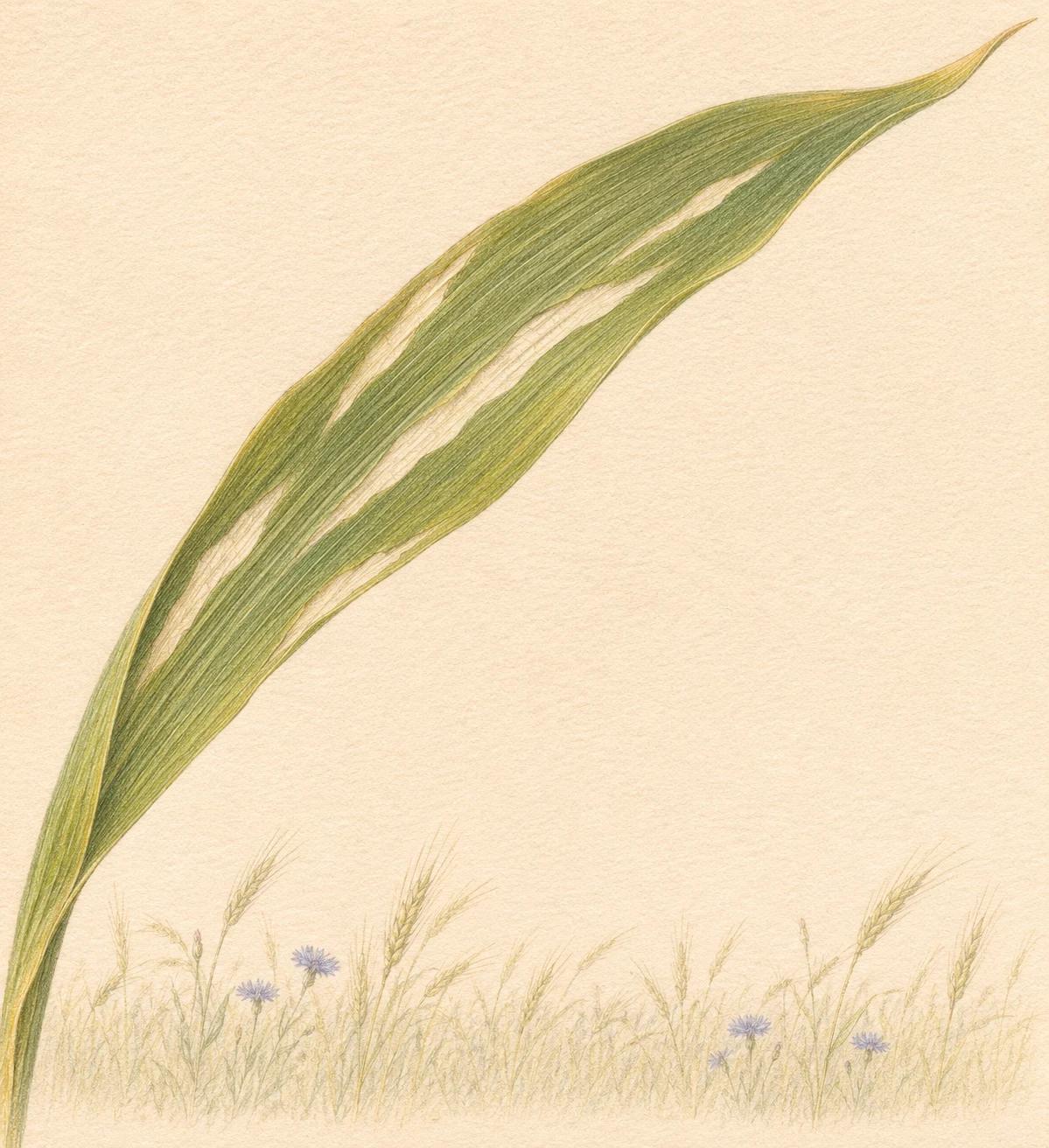
Where cereal leaf beetle larvae feed on the upper wheat leaves, narrow, pale streaks are left behind. How much of the leaf is lost this way can also depend on what grows at the field edge. At the edge of the fields, a Swiss research team sowed cornflowers, coriander and buckwheat, among other plants. The plants were meant to provide food and shelter for the beetle's natural enemies. The team investigated in the field whether the wheat benefits as well. [1] [3]
Two spots in the same field
In spring 2012, the team led by Matthias Tschumi had a three-metre-wide flower strip sown in each of 15 winter wheat fields in the cantons of Zurich and Aargau. In 15 other fields, the control strip of the same width consisted of winter wheat. Five flower strips dropped out because the seed emerged poorly or wild herbs overgrew them. The analysis included the ten fields with successful flower strips and all 15 control fields. [1]
From the strip edge, the team chose a first distance at random in each field. The second sampling point was always exactly ten metres further into the wheat. At the end of May and in mid-June, the researchers counted larvae at each point on 50 tillers, that is, on individual stems with their leaves. In mid-June they also estimated how much of the leaf area of these tillers had been eaten. [1]
Two fields, same sampling stretch
Field with flower strip
Control field with wheat strip
- Strip edge
- 0 m
- ① Near sampling points
- 0.6–10.3 m
- ② Far sampling points
- 10.6–20.3 m
- Example pair
- 5 / 15 m
On average, per ten wheat tillers, there were five larvae next to the control strips and three next to the flower strips. In both sampling ranges, the team found fewer larvae next to the flower strips. Across both ranges, leaf damage next to the flower strips was 61 percent lower than in the control fields. Close to the edge, a similarly small leaf area was eaten in both groups. Farther inside, damage was greatest in the control fields. Whether the difference between the field groups increased with distance was statistically inconclusive. The outermost sampling point was 20.3 metres from the strip edge. [1]
View damage at the two sampling points in original Figure 1cFrom leaf to harvest
In the flower strips, the team caught more ground beetles and predatory bugs than in the control strips. In the adjacent wheat there were fewer cereal leaf beetle larvae even before full flowering. The researchers suspect that the plants offered the predators early cover and alternative prey. They did not observe which predator ate how many larvae. [1]
Did the field also yield more grain in the end? The Swiss team did not measure yield. [1] A later analysis of 35 field studies on pest control and pollination included the Swiss experiment. On average, natural pest control was better next to flower strips. Eleven studies provided yield data from various crops. Across these eleven studies, no reliable yield difference could be demonstrated. [2]
What the eleven yield studies show
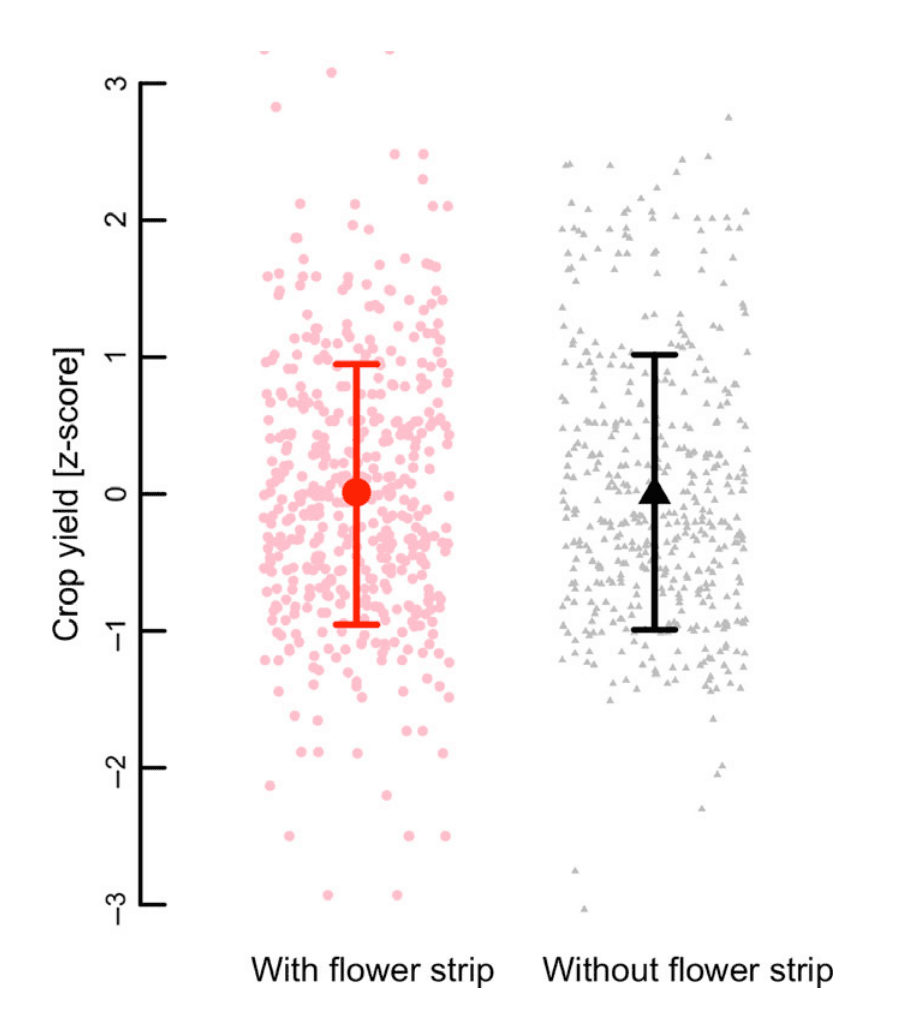
The two prominent symbols with error bars show the estimated mean standardized yields, the bars their 95% confidence intervals. Red and round stands for fields with flower strips, black and triangular for fields without flower strips. Across the eleven studies, no reliable yield difference emerged.
Open figure in original sizeOriginal figure in colour, explained separately. Albrecht et al. (2020), Ecology Letters 23, 1488–1498, Fig. 5. © 2020 The Authors. DOI · License CC BY 4.0
Sources
[1] M. Tschumi, M. Albrecht, M. H. Entling, K. Jacot (2015). High effectiveness of tailored flower strips in reducing pests and crop plant damage. Proceedings of the Royal Society B 282, 20151369, Sections 2a–c, Table 1, Figures 1 and 2, Discussion.
Open original source [1][2] M. Albrecht et al. (2020). The effectiveness of flower strips and hedgerows on pest control, pollination services and crop yield: a quantitative synthesis. Ecology Letters 23, 1488–1498, Figure 5.
Open original source [2][3] Landwirtschaftskammer Schleswig-Holstein: Pflanzenschutz-Ratgeber Ackerbau, Frühjahr 2020, p. 21 („Getreidehähnchen“).
Open original source [3]